
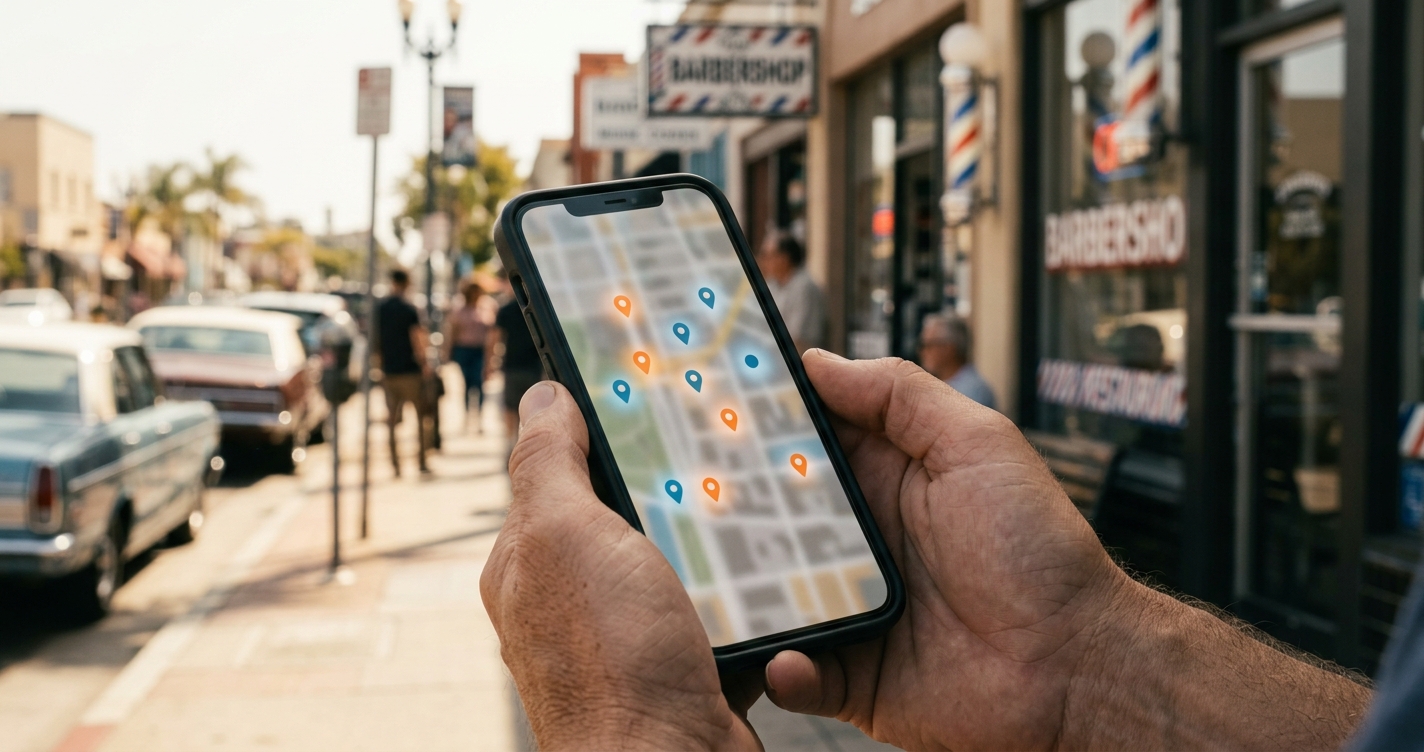
# AI Search: Why Only 8 of 200 SD Barbers Show Up
I asked ChatGPT "best barber in San Diego" last week. It recommended 5 shops. I asked Claude the same question — it cited 3. Google's AI Overview mentioned 4.
San Diego has over 200 barbershops. Only 8 unique shops appeared across all three AI systems combined. The rest were invisible.
I ran the same test for dentists, plumbers, restaurants, and real estate agents. Same pattern. AI search recommends a tiny fraction of local businesses — and the ones it picks share specific traits.
AI Search Picks Winners Differently
Google's traditional algorithm ranks websites. AI systems recommend businesses. There's a critical difference.
Rankings depend on backlinks, page speed, and domain authority. AI recommendations depend on structured data, review signals, and citation-worthy content.
Here's what the 8 barbershops that appeared had in common:
- Average 347 Google reviews (vs. 42 for those that didn't appear)
- All had FAQ schema on their websites
- 7 of 8 had posted on Google Business Profile within the last 14 days
- All had consistent NAP (name, address, phone) across 30+ directories
The barbershops that didn't appear? Most had outdated websites, no schema markup, and hadn't posted on their GBP in months.
What Business Owners Can Do This Week
You don't need a complete SEO overhaul to start appearing in AI search. Here are three things you can do this week — no technical skills required.
Your quick checklist for the week:
- Ask 5 recent customers for a review using a direct link and a specific prompt.
- Post a photo and 2-3 sentences on your Google Business Profile today.
- Add your 5 most-asked customer questions, with clear answers, to your website.
Ask for 5 Reviews This Week
AI systems weight review volume and recency heavily. If you served 20 customers this week, text 5 of them a direct link to your Google review page.
Don't say "leave us a review." Say "Would you mind sharing what you liked about your visit? Here's the link — takes 30 seconds."
Most businesses get a 20-30% response rate with a direct ask. That's 1-2 new reviews per week, which compounds fast.
Post on Your Google Business Profile Today
Open the Google Business app on your phone. Tap "Add update." Share a photo of your work, your team, or your space. Write 2-3 sentences about what you do.
That's it. Google tracks GBP activity and AI systems check how recently a business has engaged. A single post puts you ahead of the 74% of San Diego businesses that haven't posted in 30+ days.
Add FAQ to Your Website
Pick the 5 questions customers ask you most. Write clear, specific answers. Add them to your homepage or main service page.
Example for a dentist:
> How much does teeth whitening cost in San Diego? > Professional teeth whitening at our San Diego office ranges from $299 to $599 depending on the treatment. Take-home kits start at $149. We offer payment plans through CareCredit.
That specific, detailed answer is exactly what AI systems cite. Vague answers like "contact us for pricing" get ignored.
The Numbers Behind AI Visibility
I've been tracking AI visibility for San Diego businesses across multiple industries. Here's what the data shows:
| Metric | AI-Visible Businesses | Invisible Businesses |
|---|---|---|
| Avg. Google Reviews | 187 | 34 |
| GBP Posts (last 30 days) | 3.2 | 0.4 |
| FAQ Schema Present | 82% | 11% |
| Citation Count (directories) | 47 | 12 |
| Review Response Rate | 91% | 23% |
The gap isn't about budget. It's about consistency. The AI-visible businesses do simple things repeatedly. The invisible ones did them once — or never.
It helps to understand why each of these metrics carries weight with AI systems. Review count and recency act as a proxy for whether a business is currently active and trusted — an assistant like ChatGPT or Gemini has no way to visit your shop, so it leans on the volume and freshness of what real customers have written. GBP posting works the same way: a profile that was updated this week signals a business that's open and operating, while one that's gone quiet for months reads as a risk. FAQ schema and citation count solve a different problem — they make your information machine-readable and cross-verifiable. When the same name, address, and phone number appear consistently across dozens of directories, an AI system can confirm your details with confidence and is far more willing to surface you in an answer. Review response rate rounds this out by showing engagement; a business replying to 91% of its reviews looks attentive, and that pattern of interaction is something these systems can detect and reward.
The practical takeaway is that no single metric carries you. A business with 300 reviews but no schema and a stale profile still leaves gaps that keep it out of the trusted pool. The AI-visible businesses in this data tended to be reasonably strong across every row of the table — not exceptional in one area and absent in the others. That's good news for smaller operators, because it means you're not competing on the size of any single number. You're competing on whether you cover all the bases consistently, which is a matter of habit rather than budget. Pick one metric where you're weakest, close that gap over the next month, then move to the next. Over a quarter, that steady work moves you from the invisible column into the visible one.
Why This Matters More Every Month
Google's AI Overviews appeared in 14% of searches in early 2025. By late 2025, that number hit 30%+. The trajectory is clear — AI answers are becoming the default experience for local search.
ChatGPT's web browsing and Gemini's real-time search are growing even faster. When someone asks their phone "find me a good plumber near me," the AI picks from a small pool of businesses it trusts.
If you're not in that pool today, you're losing leads you'll never even know about.