Know what ChatGPT, Claude, Gemini, and Grok say about your business
When someone asks an AI assistant for the best option in your area or your category, it names somebody. The AI Visibility Tracker asks the four major assistants the exact questions your customers ask, records whether they name you or a competitor, and turns the answers into a score you can watch move.
Free AI-visibility scan · No credit card · Cancel anytime
Set up in 3 simple steps
Tell us who you are
Your business, services, and service area. From that we build the question set your customers actually ask — "best [your service] near me," comparisons, and buying questions.
We ask the four assistants
Every scan cycle, ClawSignal puts those questions to ChatGPT, Claude, Gemini, and Grok for real — the same way a customer would — and records every answer verbatim.
You see who got named
Named or not, per assistant, per question — share of voice, the competitors cited instead, and the trend over time. Real answers, stored in your portal, never estimates.
Flying blind
- Customers ask AI assistants who to call — you never see those answers
- Competitors get recommended and nothing tells you
- No way to know if your SEO work changed what AI says
- The channel grows every month, invisibly
With the AI Visibility Tracker
- Every scan shows the actual answers, per assistant
- Named competitors are listed — you know exactly who wins each question
- Share of voice becomes a trend you can watch move
- The same subscription does the SEO work that changes the answers
What you get
- Real answers from ChatGPT, Claude, Gemini, and Grok — not estimates
- Share of voice: how often you are the recommendation
- Per-assistant citation rates, so you see where you are strong and where you are invisible
- Who gets recommended instead of you, by name
How it works
Each scan cycle we put your highest-intent questions to all four assistants, log every answer, and record whether your business was named. Results land in your portal as share of voice, per-platform rates, and a week-over-week trend — over 1,200 AI answers checked and counting.
AI search is early: many local questions have low measured AI demand today. We show you the real demand number next to every tracked question — a zero says "low AI demand," never a made-up figure.
Reading share of voice like an owner
One reading is weather; the trend is climate. Assistants vary their answers run to run, so a single scan proving you were named — or missed — means little on its own. The scheduled cadence exists to smooth that noise into a line you can trust, and the portal keeps every raw answer underneath the line so nothing hides in an average.
The number to watch is share of voice per assistant: of the businesses named for your questions, how often it was you. When the monthly work ships — content, profile activity, citations — that is the number it exists to move, and the next scans say whether it did.
See who the assistants actually name
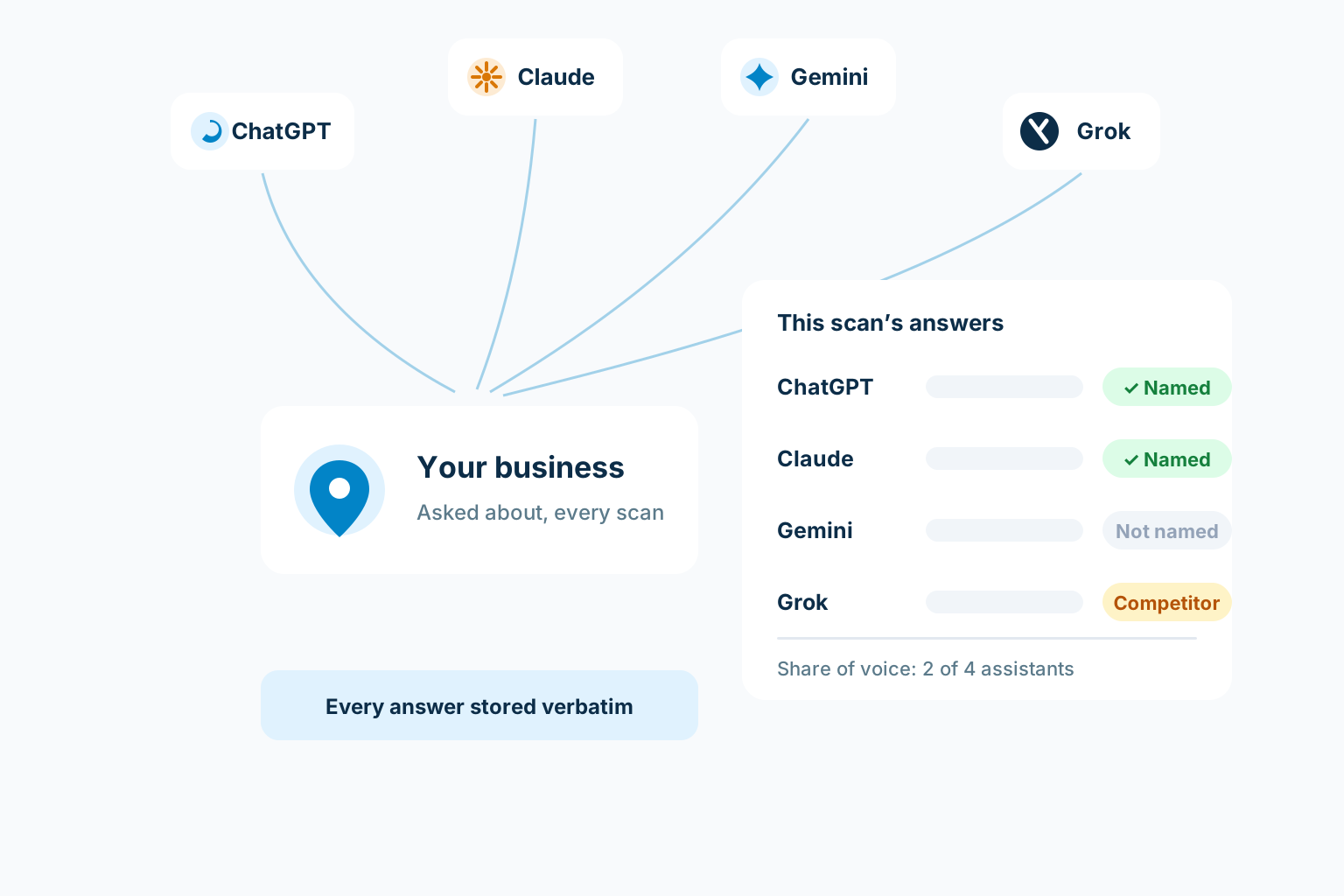
Every scan asks real buying questions and records the real answers. You see, question by question and assistant by assistant, whether your business was named — and when it was not, exactly which competitor took your spot.
- Named or not, per question, per assistant
- Competitors cited instead, listed by name
- Every raw answer stored verbatim in your portal
Illustrative layout — decorative shapes, not data. Your real numbers come from your scans, stored verbatim in your portal.
Watch your share of voice move
One number per assistant: of the businesses named for your questions, how often it was you. Scans repeat on a schedule, so the number becomes a trend — and the monthly work this subscription ships is what pushes it.
- Share of voice per assistant, every cycle
- Trend over time, not a one-off screenshot
- Paired with the SEO work that moves it
Illustrative layout — decorative shapes, not data. Your real numbers come from your scans, stored verbatim in your portal.
AI Visibility Tracker FAQ
What is the best AI visibility tool for a local business?
One that shows real answers, not estimates. ClawSignal asks ChatGPT, Claude, Gemini, and Grok your customers’ actual questions every cycle and records whether you were named — share of voice, per-assistant rates, and the competitors cited instead.
How do I get my business recommended by ChatGPT?
AI assistants recommend businesses with strong, consistent signals: reviews, accurate listings, structured data, and content that answers buyer questions. ClawSignal tracks whether the four major assistants name you, then runs that signal work — and re-measures so you see movement.
Is an LLM SEO tool different from normal SEO software?
Yes. Classic SEO software tracks Google positions. An LLM SEO tool measures whether AI assistants cite you in their answers — a different surface with different signals. ClawSignal does both, and never blurs the two numbers.
How often do the AI visibility scans run?
Twice a month on Starter and weekly on Growth — enough cadence to turn noisy single answers into a readable trend. Every raw answer is stored verbatim in your portal, so the trend is auditable, not summarized away.
More features
Put AI Visibility Tracker to work
Start with a free scan. ClawSignal finds the strongest opportunity, prepares the work, and keeps every change behind your approval.