
--- title: "SEO Agency Charges $2,000/Month. Here's What They Do." slug: seo-agency-cost-vs-ai-automation date: 2026-03-27 author: Jose Bello primary_keyword: how much should SEO cost for a small business meta_description: "Typical SEO agencies charge $1,500-3,000/mo for work AI now automates. See the cost breakdown and what you're actually paying for." category: SEO tags: [seo-pricing, seo-automation, small-business-seo, ai-seo] ---
# Your SEO Agency Charges $2,000/Month. Here's What They Actually Do (And What AI Does Now).
Your SEO agency sends a report every month. It's nice looking. Lots of graphs. They tell you they're "building authority" and "optimizing for long-tail keywords." Meanwhile, you're paying $2,000 a month and struggling to see real results.
Here's what's actually happening on their end—and what they're not telling you about how much SEO really should cost for a small business.
What You're Actually Paying For Each Month
Let's be honest: most traditional SEO agencies deliver the same thing every month. If you're paying $1,500–$3,000, here's what you get:
Content (typically 2–4 blog posts). A junior analyst writes 1,500-2,000 word posts, maybe optimizes them for keywords, publishes them. That's about 10–15 hours of work billed at their labor rate.
Monthly reporting. Pretty PDFs showing traffic, rankings, backlinks, clicks. Looks great in a slide deck. Someone spends 3–5 hours compiling this.
Google Business Profile management. A few posts, maybe a review response or two. Half an hour to two hours a month if they're paying attention.
Keyword rank tracking. They drop your 10–20 keywords into a tool (Ahrefs, SEMrush, Moz), take a screenshot, show you the movement. That tool costs them $100–300/mo but they charge it to you.
Maybe some link outreach. If you're paying on the higher end, they might spend a few hours emailing other websites to link to your content. Most of the time, they're not.
That's it. That's the $2,000/month service.
Why This Model Still Exists
Good agencies aren't scams. The ones worth hiring are doing real work—strategy, competitive analysis, client management, relationship building. But they've built a labor-based pricing model. They can only make money when someone's billing hours.
For a local dentist or plumber with a straightforward website, you don't need a strategist—you need the output. And that output can now be generated by AI for 1/8th the cost.
The Real Cost Breakdown: What You Should Actually Know
When you compare what an agency does to what automation does, the gap becomes obvious.
Let's use actual numbers:
| Deliverable | Traditional Agency | ClawSignal Starter ($79) | ClawSignal Growth ($149) |
|---|---|---|---|
| Monthly blog posts | 2–4 (outsourced writing) | 2 AI-written posts | 4 AI-written posts |
| Keyword rank tracking | 10 keywords in shared report | 10 keywords, live dashboard | 25 keywords, live dashboard |
| GBP posts | 2–4 per month (if done) | 4 automated posts | 8 automated posts |
| ChatGPT visibility tracking | Not available | Live tracking, 3 keywords free tier | Full visibility data + AI competitor tracking |
| Website analytics dashboard | Included (their tool) | Your own GA dashboard | Your own GA dashboard |
| AI optimization suggestions | None | Automated | Automated |
| Monthly report | PDF (hours of labor) | Automated dashboard, real-time | Automated dashboard, real-time |
| Cost per blog post | ~$500–750 | ~$40 | ~$37 |
| Cost per month | $1,500–3,000 | $79 | $149 |
See the difference? At the traditional agency rate, you're paying $500–750 per blog post. With ClawSignal Starter, that same post costs $40.
The agency isn't lying when they say they're creating content. They are. But they're also paying writers, project managers, and account managers. That overhead gets passed to you.
What You're Not Getting From Agencies (But Should Be)
Here's where agencies actually fall short:
No live dashboard. You get a monthly report. If they made a mistake on Tuesday, you won't know until next month. With ClawSignal, you see your visibility in real-time.
Limited keyword tracking. Most agencies watch 10–20 keywords. If your real ranking opportunity is on 50 or 100 different keyword variations, they miss it. Not because they're bad—because tracking more keywords costs them money.
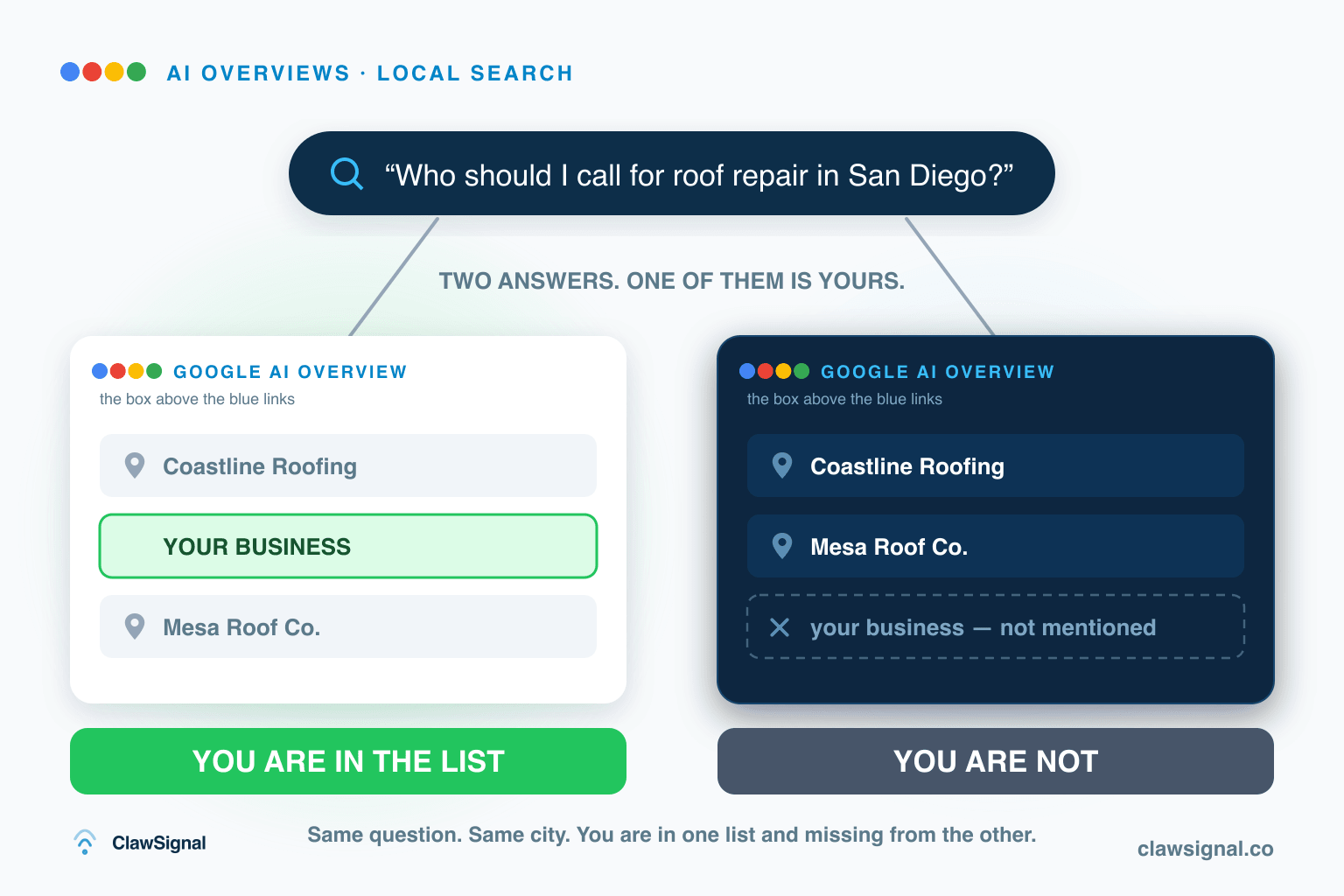
No ChatGPT visibility tracking. Your customers are using ChatGPT to search. Are you showing up? Most agencies aren't even tracking this yet. ClawSignal tracks your visibility in AI chatbot answers, not just Google. If you want to dig deeper into this, we cover it in our guide on how ChatGPT surfaces local businesses.
Manual processes everywhere. Content calendars are spreadsheets. Reports are built in PowerPoint. If something changes, someone has to manually update it. That's slow and prone to errors.
No visibility into what's actually working. Agencies show you traffic and rankings, but they often don't show you why certain posts rank. AI can show you exactly what your top-performing competitors did differently.
Who Should Still Use a Traditional Agency?
This isn't a hit piece on agencies. Here's when they actually make sense:
If you're a large e-commerce site, you probably need someone managing link-building, handling PR outreach, running competitive intelligence. That's strategy work, and good strategists are worth the $3,000–5,000/month.
If your industry is highly competitive and complex (like finance, healthcare, or SaaS where you need deep domain knowledge), an experienced agency pays for itself.
If you need relationship management—someone to advocate for SEO inside your company, present to the board, manage multiple stakeholders—hire an agency.
But if you're a local dentist, landscaper, plumber, barber, or e-commerce store selling a straightforward product? You don't need relationship management. You need results. And AI can deliver those results at 1/8th the cost.
The Math is Brutal for Agencies Right Now
Let's say you've been paying an agency $2,000/month for 24 months. That's $48,000. Over two years, you got:
- 48–96 blog posts (let's say 72 average)
- Monthly reports you probably never read again
- Maybe 50–100 GBP posts
- Keyword tracking on 10–20 keywords
- Zero visibility into ChatGPT or AI search
If you switched to ClawSignal Starter at $79/month for those same 24 months, you'd pay $1,896 and get:
- 96 blog posts (minimum, with room to scale)
- Real-time dashboard (not monthly PDFs)
- 200+ GBP posts
- Live tracking on 50 keywords
- ChatGPT visibility tracking included
That's $46,000 you don't spend. That's also 100% transparency into your performance—not a report you get once a month.
What Changed? The Bottleneck Moved
Five years ago, the bottleneck was writing good content. You needed a writer, an editor, someone who understood SEO. That was scarce and expensive.
Today, the bottleneck is strategy. Which keywords matter to your business? What problem are you solving better than competitors? Where should you focus next?
AI solved the writing and optimization problem. What it can't do is ask the right questions or build your business strategy. But for the execution part—the content, the tracking, the optimization—AI is faster, cheaper, and often better. If you want to see where the ranking effort should actually go, Google's helpful-content guidance is a solid baseline for what quality looks like.
Agencies haven't fully adapted to this shift yet. Many are still charging $2,000/month to do work that can be done for $79.
How to Know If Your Agency is Worth It
Ask yourself these questions:
- Am I seeing measurable growth? If you've been paying $2,000/month for a year and your traffic is flat, you're overpaying. Period.
- Can I understand what they're doing? If their explanation requires a glossary, that's a red flag. Good work is explainable.
- Are they tracking things that matter to me? If they're tracking rankings but your business cares about leads, they're pointing at the wrong metric.
- Could I get 80% of the same results for 20% of the cost? If yes, you're overpaying for convenience.
If you answer "no" to most of these, it's probably time to make a change.
The Real Value Proposition of Automation
ClawSignal's Starter tier ($79/month) isn't positioned as "cheaper than agencies." It's positioned as "what happens when you remove the labor overhead."
When you automate content creation, keyword tracking, and GBP management, the cost drops dramatically. But what you gain in return is transparency and control.
With an agency, you're trusting their judgment on what to write, when to write it, which keywords matter. With automation, you can see the data in real-time and adjust instantly.
Your AI is like having a junior SEO analyst working 24/7—except it doesn't take vacation, doesn't leave for a new job, and charges $79/month instead of $4,000/month in salary.
For a local business or small e-commerce site, that's a serious shift in what your budget can do.
What Agencies Need to Do to Compete
If you're reading this as an agency owner: you're not losing because you charge too much. You're losing because you haven't made the shift from labor-based to value-based pricing.
The agencies that will survive are the ones who:
- Use AI to handle execution, so their team can focus on strategy
- Charge based on results, not hours
- Give clients real-time dashboards, not monthly reports
- Specialize instead of claiming to do everything
- Build long-term partnerships instead of optimizing for monthly fees
The ones that are going to struggle are the ones that keep billing 40 hours a month to do things AI can do in 40 minutes.
Getting Started: What to Do Next
If you've been paying $1,500–3,000/month and seeing minimal results, here's your play:
Try the free tier. Sign up at clawsignal.co/signup and track 3 keywords for free. See how you rank across Google, Bing, and ChatGPT. No credit card. Just data.
Run the numbers yourself. Calculate what you've spent on agencies over the last two years. Then calculate what you could get for that same budget with automation. The gap will shock you.
Talk to your team. If you're in-house, bring this to your boss or marketing lead. If you're a solo founder, run through your budget. The conversation might change everything.
Keep the human strategist if they're worth it. If your agency is genuinely helping you think through your business, that's valuable. But if they're primarily selling you content and reports, it's time to move.
If you want a fuller picture of what execution should look like month to month, our San Diego local SEO guide walks through it in detail. Not sure where you stand right now? Grab the free scan and see your baseline before you change anything.
FAQ: SEO Pricing and AI Automation
Q: How much should SEO cost for a small business?
A: That depends on your definition of "cost." If you're paying $2,000/month to a traditional agency, you're paying for their overhead. If you're using AI automation, you're looking at $79–149/month. Both can work—the question is whether you're getting ROI. Track your leads and revenue, not just rankings.
Q: Can AI really replace an SEO agency?
A: AI can replace 80% of what most agencies do—the content creation, keyword tracking, and reporting. It can't replace strategy, relationship building, or industry expertise. If your agency is mostly providing execution, AI will eat their lunch. If they're providing strategy, they're safe (for now).
Q: Is DIY SEO better than paying a professional?
A: Only if you have the time and knowledge. For most small business owners, hiring an agency (or using an AI platform) beats doing nothing. The real question is ROI. An agency that costs $2,000/month needs to generate at least $6,000 in additional revenue per month to be worth it. Can you measure that? If not, you're flying blind.
Q: What about backlinks and authority building?
A: Traditional agencies often oversell link-building. Most small local businesses need 20–50 quality local citations, not thousands of backlinks. Those citations cost $50–200 total. AI platforms are getting better at helping you build them, but it's not revolutionary work.
Q: Should I cancel my agency and switch to automation?
A: Not necessarily. If your agency is delivering measurable results and you have a good relationship, there's value in that. But if you're paying them and seeing no growth, or if they can't explain what they're actually doing, then yes—it's time to move.