Local SEO is the practice of optimizing your business to appear in location-based search results, including Google Maps, the local pack, and AI search platforms, for customers searching in or near San Diego. With over 90,000 small businesses in the San Diego metro area competing for the same customers, local SEO determines whether your phone rings or sits silent.
This guide covers every ranking factor, optimization technique, and strategy that San Diego businesses need to dominate local search in 2026.
What Local SEO Is and Why It Matters in San Diego
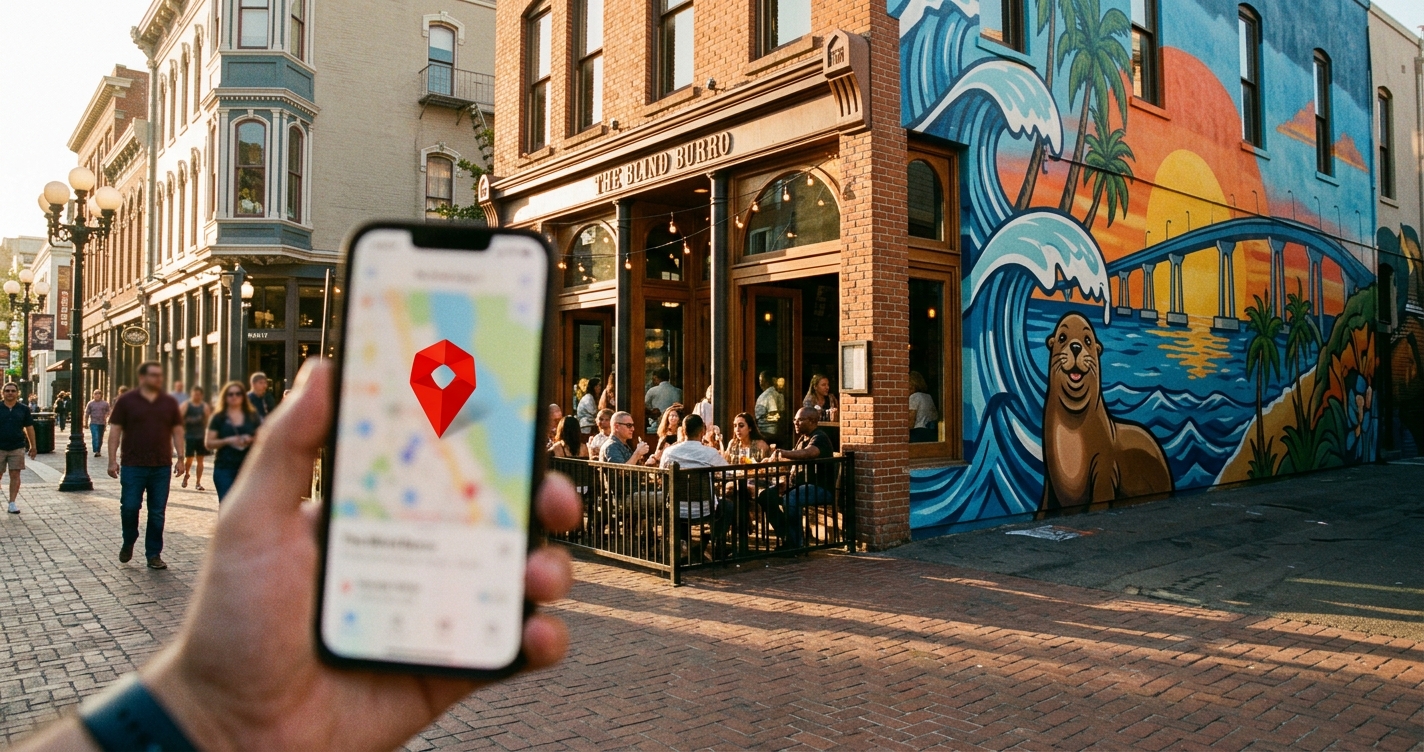
Local SEO differs from traditional SEO in one critical way: geography. When someone searches "dentist near me" or "best tacos in Pacific Beach," Google does not show the same results it shows someone in Los Angeles or Dallas. It shows results based on the searcher's physical location, combined with relevance and business reputation signals.
San Diego's local search landscape is uniquely competitive. The city spans 372 square miles across dozens of distinct neighborhoods — from La Jolla to Chula Vista, Pacific Beach to Rancho Bernardo. Each neighborhood functions as its own micro-market with different competitors and different customer behavior patterns.
Three factors make San Diego local SEO particularly challenging:
- Tourist traffic — San Diego draws 30+ million visitors annually, creating a mix of local and tourist searches that complicates keyword targeting
- Military presence — With multiple military bases, there is a large transient population constantly searching for new service providers
- Cross-border dynamics — Proximity to the Mexican border creates bilingual search patterns and unique competitive dynamics
For a broader overview of how San Diego businesses approach this, see our post on San Diego SEO: What Your Competitors Know.
Google Maps Ranking Factors
Google Maps rankings — the local 3-pack that appears at the top of local search results — are the single most valuable real estate in local SEO. Here are the three primary ranking factors Google uses:
Google explains these signals directly in its own local-ranking guidance, which is worth reading alongside this section.
| Ranking Factor | What It Measures | How You Influence It |
|---|---|---|
| Relevance | How well your business matches the search query | GBP categories, business description, website content, services and products |
| Distance | How close your business is to the searcher | Service area settings, local content, genuine multiple locations |
| Prominence | How well-known and reputable your business is | Reviews, citation consistency, backlinks, brand searches, engagement |
Relevance
Relevance measures how well your business matches the search query. The primary relevance signals are:
- Google Business Profile categories — Your primary category is the strongest relevance signal. Choosing "Mexican Restaurant" instead of just "Restaurant" dramatically improves your relevance for Mexican food searches.
- GBP business description — Include your core services and service area naturally.
- Website content — Your site's content reinforces your relevance for specific services.
- GBP services and products — List every service you offer with descriptions.
Get your categories and services right by reading our GBP Categories and Services Setup Guide.
Distance
Distance is how close your business is to the searcher's location. You cannot change your business address, but you can influence distance factors through:
- Service area settings — If you serve customers at their location (plumbers, HVAC, mobile services), set accurate service areas in GBP.
- Local content — Creating neighborhood-specific content signals relevance to searches from those areas.
- Multiple locations — If you have genuine multiple locations, each one targets its surrounding geography.
Prominence
Prominence measures how well-known and reputable your business is. Google determines prominence through:
- Review quantity and quality — More positive reviews = stronger prominence signal
- Citation consistency — Your business listed accurately across directories
- Backlinks — Links from local and industry-relevant websites
- Brand searches — How often people search for your business by name
- Engagement metrics — Click-through rates, calls from GBP, direction requests
Google Business Profile Optimization for San Diego
Your Google Business Profile is the control panel for your local search presence. Here is the complete optimization checklist:
Complete Every Section
Google rewards complete profiles with higher visibility. Fill out every available field:
- Business name (exact legal name, no keyword stuffing)
- Address (or service area for mobile businesses)
- Phone number (local San Diego area code preferred)
- Website URL
- Hours (including special hours for holidays)
- Business description (750 characters, include key services and areas)
- Categories (1 primary + up to 9 additional)
- Services with descriptions
- Products if applicable
- Attributes (women-owned, veteran-owned, wheelchair accessible, etc.)
See our deep dive: GBP Attributes: Why Veteran-Owned and Other Tags Win Clicks.
GBP Posts Strategy
Google Business Profile posts are a free, underused tool that keeps your profile fresh and signals activity to Google's algorithm. For San Diego businesses, an effective posting schedule looks like:
- Weekly updates — New offers, seasonal services, company news
- Event posts — San Diego-specific events, community involvement
- Offer posts — Limited-time promotions with clear CTAs
- Photo posts — Recent project photos, team photos, location photos
Most San Diego businesses neglect this entirely. Read why that is a mistake: GBP Posts: 3 Minutes That 74% of SD Businesses Skip and our strategy guide on GBP Posts: The Weekly Strategy That Drives Calls.
Photos and Visual Content
Businesses with more than 100 photos on their GBP receive significantly more clicks and direction requests than those with fewer than 10. Prioritize:
- Exterior shots (helps Google verify your location)
- Interior shots (builds trust)
- Team photos (humanizes your business)
- Product and service photos (shows what you do)
- Before-and-after photos (powerful for contractors, dentists, detailers)
Our photo optimization guide: GBP Photos That Actually Rank Local Businesses
Q&A Management
The Questions & Answers section on GBP is a ranking factor most businesses ignore. You can (and should) seed your own Q&A with common customer questions and detailed answers. This content feeds into AI responses and helps your Maps ranking.
Read more: GBP Q&A: The Ranking Feature Your Competitors Ignore
The Citation Foundation
Citations are mentions of your business name, address, and phone number (NAP) across the internet. Consistent citations build trust with Google and AI platforms alike.
Core Citation Sources for San Diego
Every San Diego business needs accurate listings on:
- Google Business Profile
- Yelp
- Facebook Business
- Apple Maps / Apple Business Connect
- Bing Places
- BBB (Better Business Bureau)
- San Diego Chamber of Commerce
- YellowPages / Superpages
- Foursquare / Swarm
Industry-Specific Directories
Depending on your industry, add listings to:
- Restaurants: TripAdvisor, OpenTable, DoorDash, Yelp Reservations
- Medical: Healthgrades, Vitals, WebMD, Zocdoc
- Legal: Avvo, FindLaw, Justia
- Home Services: Angi, HomeAdvisor, Houzz, Thumbtack
- Auto: CarFax, RepairPal, AutoMD
NAP Consistency Rules
Your NAP must be identical everywhere. Differences like "St" vs "Street" or a different phone number format can dilute your citation signals. Audit your citations quarterly and fix any inconsistencies.
Reviews: Your Most Powerful Ranking Signal
Reviews are arguably the strongest local SEO signal in 2026. Here is the comprehensive review strategy:
Getting More Reviews
The most effective approach is asking at the point of highest customer satisfaction. For service businesses, that is immediately after completing the job. For retail, it is at checkout. For medical, it is after a successful treatment.
Create a simple review link and make it frictionless for customers. Do not offer incentives (this violates Google's terms), but do make the process as easy as possible.
Read our full strategy: How to Get More Google Reviews Without Being Pushy
Review Response Strategy
Respond to every review — positive and negative. Responses signal to Google that you are an active, engaged business. For negative reviews:
- Respond within 24 hours
- Acknowledge the issue
- Take the conversation offline
- Never argue publicly
Review Keywords and AI Impact
The text content of your reviews matters for rankings. When customers mention specific services, neighborhoods, or experiences in their reviews, it reinforces your relevance for those terms. Reviews also feed directly into AI platform responses.
Deep dive: Google Reviews: The 3 Signals That Actually Move Rankings
Content Strategy for Local SEO
Neighborhood-Specific Pages
San Diego is a city of neighborhoods. Create dedicated pages for each neighborhood you serve:
- Pacific Beach, Ocean Beach, Mission Beach
- La Jolla, Del Mar, Encinitas
- Hillcrest, North Park, South Park
- Downtown, Little Italy, East Village
- Chula Vista, National City, Imperial Beach
- Rancho Bernardo, Poway, Escondido
- El Cajon, La Mesa, Santee
Each page should include neighborhood-specific information, not just a template with the location name swapped in. Reference local landmarks, specific challenges for that area, and relevant details that demonstrate genuine knowledge.
Service Pages with Local Intent
Each core service needs its own page optimized for local search. "Plumbing" is not enough — you need "Emergency Plumbing Repair in San Diego," "Water Heater Installation San Diego," and "Drain Cleaning Services San Diego."
Blog Content Calendar
Publish at least 2-4 blog posts per month targeting:
- Local industry questions ("How much does AC repair cost in San Diego?")
- Seasonal content ("Preparing your San Diego home for Santa Ana winds")
- Neighborhood guides ("Best restaurants for business lunches in La Jolla")
- Industry news with local angles
See our Local SEO Checklist for the 6 items most San Diego businesses miss.
AI Search Impact on San Diego Local SEO
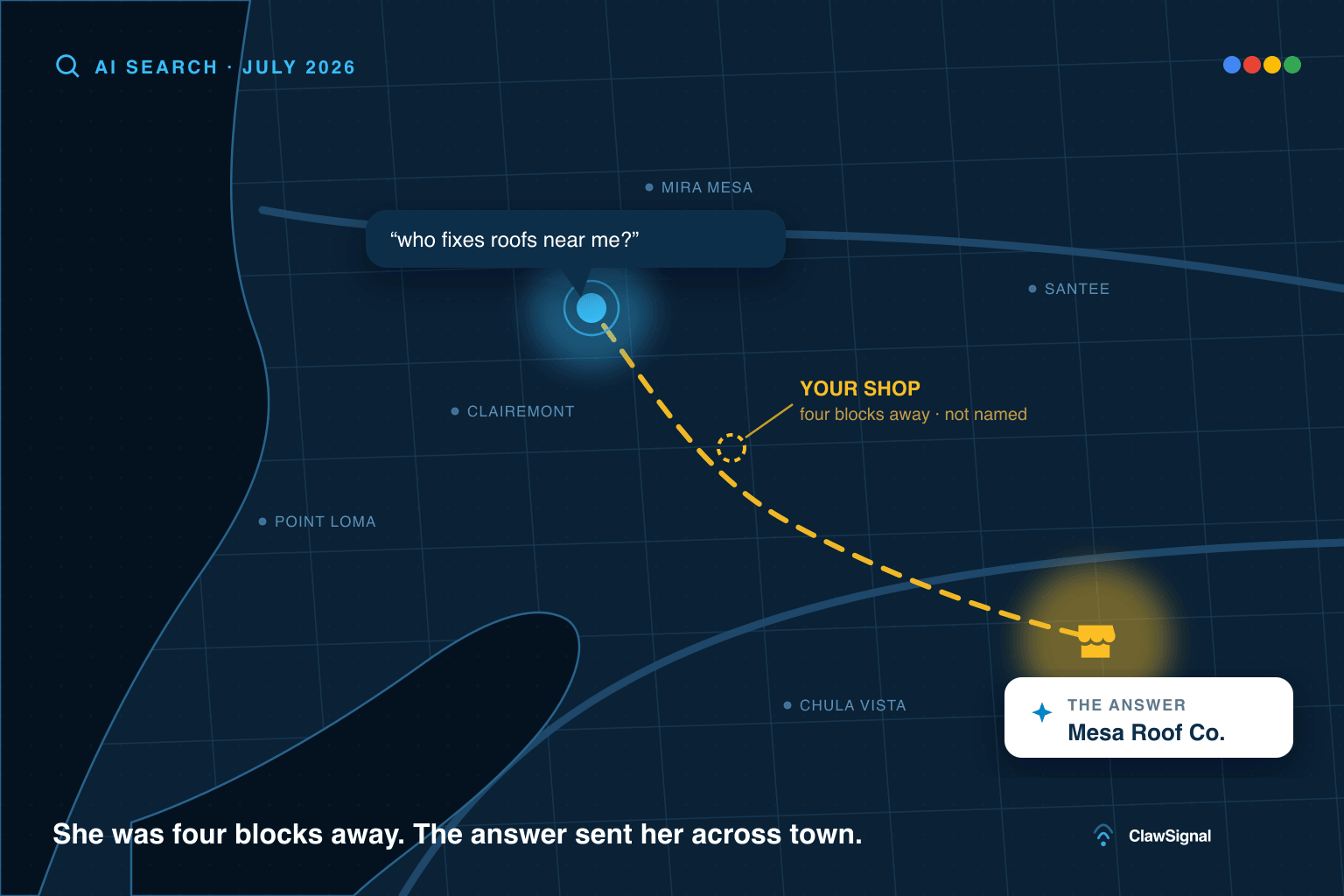
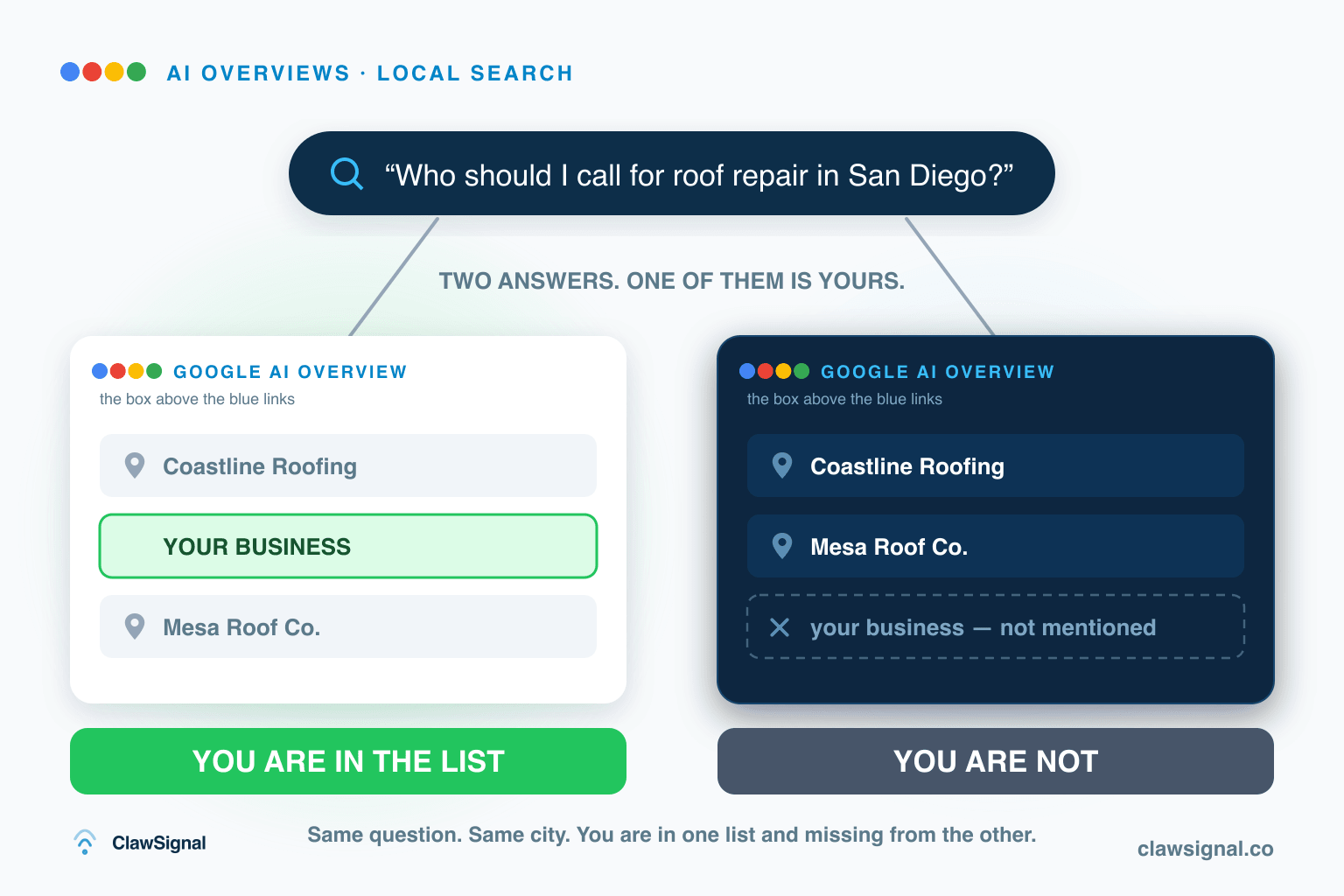
AI search is reshaping how customers find San Diego businesses. ChatGPT, Claude, Gemini, and Grok all handle local queries now, and their recommendations do not always match Google Maps results.
What Changes with AI Search
- Customers ask complete questions: "What is the best sushi restaurant in Hillcrest that is not too expensive?" instead of typing "sushi hillcrest"
- AI platforms synthesize reviews, website content, and third-party mentions into recommendations
- The top 3 AI recommendations capture the majority of attention — there is no "page 2" in AI search
- Schema markup and structured data become more important because AI platforms parse them directly
San Diego AI Search Data
When we tested AI platforms with San Diego local searches, we found that only a fraction of businesses in any category appeared in AI results. The businesses that did show up shared common traits: strong review profiles, detailed website content, active GBP profiles, and presence across multiple directories.
Read our analysis: AI Search: Why Only 8 of 200 SD Barbers Show Up and How AI Is Changing Local Search in San Diego.
Industry-Specific Tips for San Diego
Restaurants and Bars
Focus on food-specific keywords, menu schema markup, high-quality food photography, and TripAdvisor optimization. GBP attributes like outdoor seating, live music, and happy hour are critical for restaurant searches. See our GBP for Restaurants guide.
Dental and Medical Practices
Medical schema markup, HIPAA-compliant review responses, and Healthgrades optimization are essential. San Diego has over 800 dental practices competing for the same patients. Read our Dental SEO in San Diego analysis.
Home Services (HVAC, Plumbing, Electrical)
Service area optimization, emergency service keywords, and before-after photo content drive results. Angi and HomeAdvisor listings are critical secondary citation sources.
Salons, Spas, and Beauty
Visual content dominates this category. Instagram integration, before-after galleries, and booking link optimization are the primary differentiators. See our Local SEO for Salons & Spas guide.
Barber Shops
A tight niche where GBP optimization and review volume make outsized differences. Our SEO for Barbers guide covers the specifics.
Technical SEO for Local Businesses
Site Speed
Google uses page speed as a ranking factor. San Diego businesses with slow websites lose rankings to faster competitors. Target under 2.5 seconds for Largest Contentful Paint.
Mobile Optimization
Over 60% of local searches happen on mobile devices. Your site must be fully responsive with tap-friendly buttons, readable text without zooming, and fast loading on cellular connections.
SSL Certificate
HTTPS is a baseline requirement. Google flags non-secure sites, and AI platforms penalize them in recommendations.
Local Business Schema
Implement comprehensive LocalBusiness schema markup on every page. Include your NAP, hours, service area, and accepted payments in structured data format.
Measuring Local SEO Success
Track these metrics monthly to measure progress:
- Google Maps position for your top 10 keywords
- GBP impressions and actions (calls, directions, website clicks)
- Review count and average rating growth
- Organic traffic from local keywords
- AI visibility across ChatGPT, Claude, Gemini, and Grok
- Citation accuracy across directories
- Phone call and form submission volume
Need help getting started? Request a free local SEO audit or explore our services.
Beyond tracking the raw numbers, the value comes from interpreting them together over time. A single month of data tells you very little; the trend across three to six months reveals whether your strategy is working. Set up a simple monthly reporting rhythm so you can compare each metric against the prior period and against the same month last year, since many San Diego industries have strong seasonal swings (tourism peaks in summer, home services spike before and after Santa Ana wind events).
When you review the numbers, connect the actions to the outcomes rather than reading each metric in isolation:
- Rising impressions but flat calls usually means you are showing up but not compelling clicks — revisit your GBP photos, primary category, and review rating.
- Strong Maps position but weak website traffic points to a gap between your profile and your site; check that your GBP links to a relevant, fast-loading page rather than a generic homepage.
- Good rankings but poor form submissions is often a conversion problem, not a visibility problem — the fix lives on your landing page, not in your SEO.
A few measurement practices help you avoid drawing the wrong conclusions:
- Track from a consistent location. Because Maps results shift with the searcher's position, checking your ranking from home, from your office, and from across the county will produce different answers. Use a fixed reference point (or a grid of points across the neighborhoods you serve) so month-to-month comparisons stay honest.
- Separate branded from non-branded searches. People searching your business name by mouth are already customers; the growth signal you want is in non-branded, service-and-location queries like "water heater repair Chula Vista."
- Annotate your reports. Note the date you changed your primary category, launched neighborhood pages, or ran a review push. When rankings move weeks later, those notes let you attribute the change to a specific action instead of guessing.
- Watch leading indicators, not just lagging ones. Review velocity, new citations, and GBP engagement move before rankings and revenue do. If the leading indicators are climbing, the lagging ones typically follow within the 3-to-6-month window described earlier in this guide.
Finally, decide in advance what a "win" looks like for each metric so you are measuring against a goal rather than reacting to noise. For most San Diego businesses, meaningful progress shows up first in GBP actions and review growth, then in Maps position, and finally in phone calls and form submissions — roughly the same order in which the underlying signals compound.